
TL;DR
AI dating photos work best when they look like real moments, not studio headshots or fantasy portraits. A strong profile set should mix clear face photos, social lifestyle scenes, hobbies, and everyday settings while keeping facial accuracy and honesty intact.
A dating profile photo has one job: make a stranger feel that the person on screen is real, approachable, and worth meeting. An AI dating photo generator for candid lifestyle shots can help create that kind of image when the source selfies are clear, the prompts are grounded, and the final choices avoid over-polished results. Lifestyle photography: a portrait style that captures people in real-life situations, events, or milestones in an artistic way, with the goal of telling a story rather than only showing a face. Tools such as Looktara fit this shift toward practical, profile-ready visuals, especially for people who need dating, social, and personal-brand images without booking a full shoot.
Table of Contents
What is an AI dating photo generator for candid lifestyle shots?
An AI dating photo generator for candid lifestyle shots is a tool that learns a person's facial features from uploaded selfies, then creates realistic-looking dating profile images in casual settings such as cafes, parks, city streets, kitchens, gyms, or travel scenes. The best results look like flattering snapshots, not corporate portraits or fantasy edits.
AI dating photo generator: a software tool that creates new profile images from source selfies, usually by matching facial identity with selected outfits, poses, lighting, and backgrounds.
Competitor SERP data shows a clear pattern in 2026: top-ranking dating photo tools promise quick packs for Tinder, Bumble, and Hinge, often asking for several selfies and producing many variations. Aragon, for example, promotes a dating photo flow built around uploading 6 selfies, while another ranking product claims 80 to 180 photos in about 20 minutes. CarePhoto AI frames the category around fast, natural profile photos for dating apps.
Key insight: The useful product is not the one that makes the most dramatic photo. The useful product makes a believable first impression.
A realistic generator should help with three jobs:
- Identity match: facial structure, hair, age, and body cues remain consistent with real life.
- Dating context: images suggest interests, warmth, and lifestyle without looking staged.
- Profile variety: the set includes close-up, half-body, activity, and social-adjacent images.
Looktara can also support broader profile consistency for creators and professionals who need visuals beyond dating, such as an AI profile picture for fitness and Instagram-style branding. That matters because dating apps increasingly overlap with public social identity, especially for entrepreneurs, freelancers, and creators.
How do candid AI dating photos differ from headshots and glamour images?
Candid AI dating photos differ from headshots and glamour images because they are designed to feel spontaneous, social, and lived-in. A headshot signals professionalism, while a glamour image signals high production. A dating lifestyle image should signal presence, personality, and everyday compatibility.
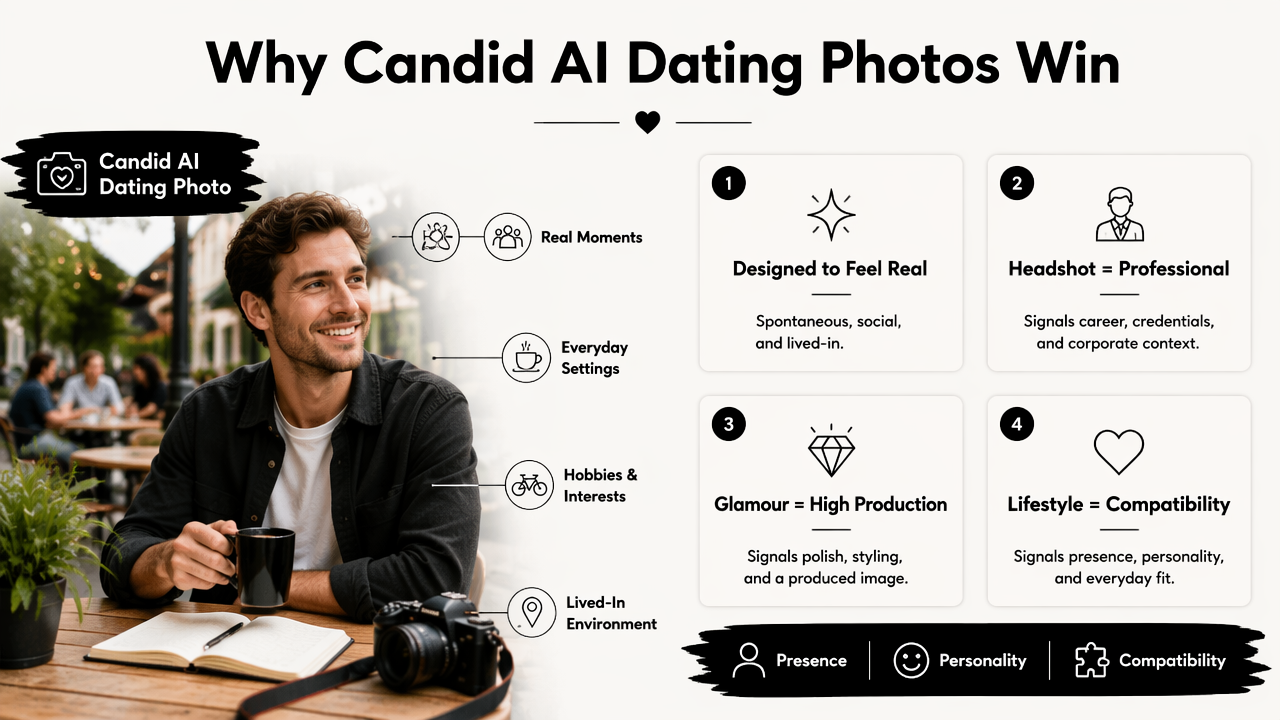
Professional headshots can help on LinkedIn, company bios, and speaker pages. For dating apps, they often feel too formal when used as the main image. This supporting topic connects naturally to the broader question of whether AI headshots belong on LinkedIn, but dating photos need a softer visual language.
Glamour-style AI images create a different risk. Perfect skin, dramatic lighting, luxury backdrops, and model-like poses can create visual distance. The person may look attractive, but the image may not feel meetable.
Comparison of dating photo styles
| Photo style | Best use | Dating app risk | Better candid alternative |
|---|---|---|---|
| Corporate headshot | LinkedIn, resumes, founder bios | Too formal or interview-like | Relaxed cafe portrait with natural smile |
| Studio glamour image | Fashion, entertainment, promo | May feel edited or unrealistic | Evening street photo with normal lighting |
| Gym mirror selfie | Fitness progress, casual social posts | Can feel repetitive or self-focused | Outdoor active shot after a run or hike |
| Travel landmark pose | Vacation memory | Can feel generic if every shot is posed | Walking through a market or sitting at a small table |
| AI fantasy portrait | Creative concept art | Can misrepresent real appearance | Everyday lifestyle scene with accurate face and body cues |
The clearest rule is simple: dating photos should look like they could have been taken by a friend. That does not mean blurry or careless. It means natural expression, believable lighting, and settings that match ordinary life.
For people balancing dating and personal brand content, a profile should not feel like an advertisement. Still, consistent visual taste helps. A creator can pair dating photos with polished social content, such as AI-generated Instagram post visuals for fitness creators, while keeping dating images more personal and less promotional.
How should a realistic dating photo set be built?
A realistic dating photo set should include 5 to 7 images that show face clarity, body context, personality, interests, and social comfort. The goal is not to display every possible version of a person. The goal is to reduce uncertainty and make the profile feel easy to trust.
Most dating apps reward quick visual understanding. A viewer should not need to guess which person owns the profile, what the person looks like currently, or whether the images are heavily edited.
A practical 6-photo dating profile mix
- Primary close-up: clear face, soft daylight, relaxed smile, simple background.
- Half-body lifestyle shot: walking, leaning at a cafe table, or standing outdoors.
- Interest photo: cooking, music, books, fitness, art, pets, or a hobby that feels real.
- Social-context photo: natural group-adjacent scene where identity remains obvious.
- Full-body casual photo: honest proportions, normal outfit, no extreme angles.
- Conversation-starter image: a specific place, activity, or style detail that invites a message.
Source selfies shape the final output. Clear input images from different angles usually create better identity consistency than one perfect selfie repeated five times. A mix of lighting conditions also helps the model understand the face without locking into one expression.
Good prompt direction should be specific but ordinary. "Smiling at an outdoor coffee shop in a navy jacket, natural afternoon light" is stronger than "make a perfect dating photo." Scenes with real-life texture tend to beat luxury clichés.
A dating profile set should answer three silent questions: what does this person look like, what would spending time with this person feel like, and does the profile seem honest?
The Looktara platform is most useful when the goal is a coherent set rather than one isolated image. A person who also posts fitness, coaching, or creator content can build adjacent assets such as AI Instagram Story visuals for fitness lifestyle updates without making dating photos feel like branded ads.
What settings, expressions, and wardrobe choices look authentic?
Authentic AI dating photos use familiar settings, relaxed expressions, and clothes that match real daily life. The image should look slightly elevated, not invented. Small imperfections, normal posture, and believable lighting often improve trust more than a flawless finish.
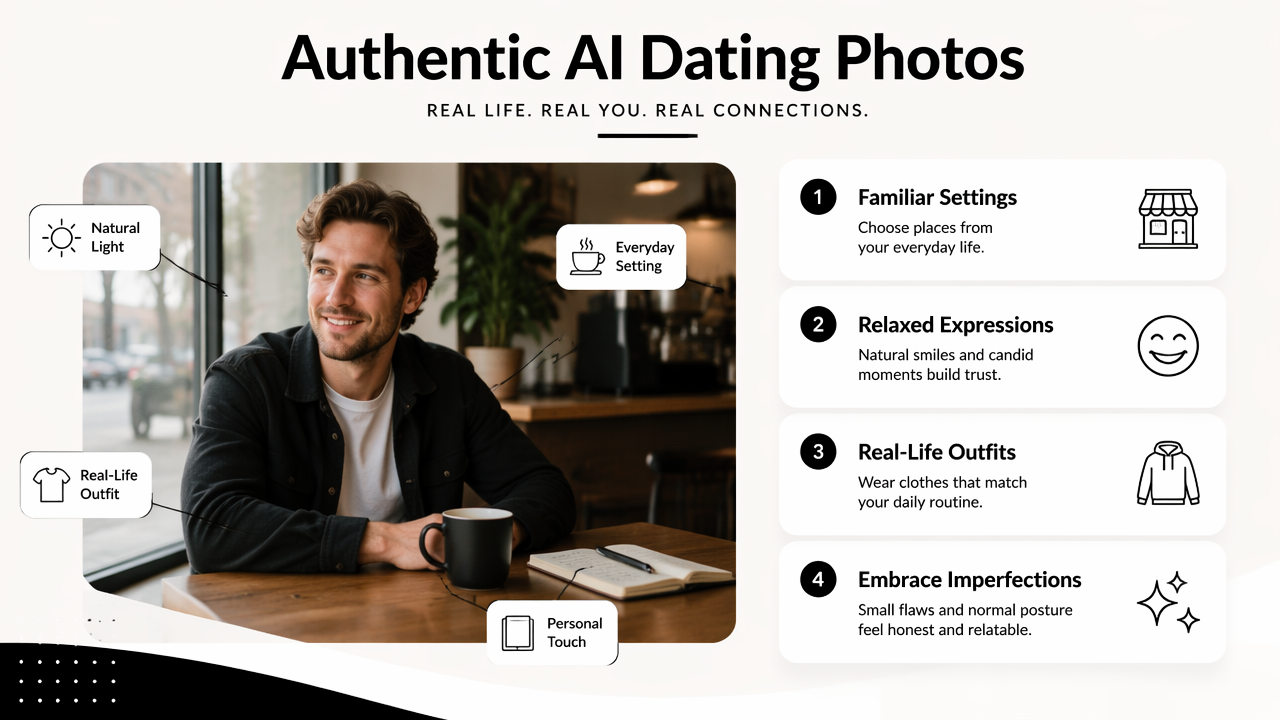
The strongest settings are specific enough to say something, but not so dramatic that they distract from the person. A quiet bookstore, casual dinner table, local park path, apartment kitchen, museum hallway, or neighborhood street can all work. A private jet, mansion, red carpet, or exotic beach may look impressive, but often feels disconnected from normal dating expectations.
Authentic prompt ingredients
- Settings: corner coffee shop, weekend farmers market, apartment balcony, city sidewalk, trail overlook, casual restaurant booth.
- Expressions: soft smile, mid-laugh, thoughtful look, friendly eye contact, relaxed candid glance.
- Wardrobe: fitted T-shirt, textured sweater, casual jacket, clean sneakers, simple dress, denim, linen shirt.
- Lighting: window light, golden hour, shaded outdoor light, warm indoor lamp light.
- Poses: holding a mug, adjusting a jacket, walking, sitting naturally, turning toward the camera.
Wardrobe should match the intended match pool and the person's real lifestyle. A founder may look good in a smart jacket, but a dating profile filled with boardroom energy can feel stiff. A fitness coach may include one active image, while five flexing photos could narrow the profile's appeal.
Expression matters as much as setting. Many AI tools overproduce symmetrical smiles and glossy eyes. Better selections show believable emotion: a real grin, a calm look, or a moment that feels interrupted in a good way.
Profile imagery also has to fit the broader digital footprint. A freelancer or creator might use AI LinkedIn post visuals for fitness and personal-brand content for public thought leadership, while choosing warmer, lower-pressure scenes for dating apps.
Common mistakes include using only sunglasses photos, selecting images with unclear hands, choosing outfits never worn in real life, or creating a body type that does not match offline appearance. Those choices may increase short-term attention, but they raise the chance of disappointment later.
A good final review should check:
- Does the face look like the same person across every photo?
- Would the outfit make sense on a normal weekend or date?
- Is at least one image clearly recent in style and appearance?
- Does the profile show personality beyond attractiveness?
- Could a first date recognize the person quickly?
FAQs about AI dating photos in 2026
AI dating photos in 2026 are most effective when they improve presentation without changing identity. The safest use is enhancement through better settings, lighting, and variety, not reinvention. Dating platforms and users both place more value on authenticity as AI images become easier to create.
What should happen next in 2027?
AI dating photo tools are likely to add stronger realism checks, identity consistency scoring, and disclosure controls in 2027. Competitor pages already mention "realness" as a selling point, which suggests the market is moving away from pure beauty edits and toward believable profile accuracy.
Dating apps may also become stricter about synthetic images. A practical response is to keep at least one real, recent phone photo in the profile set. That creates a trust anchor and helps AI-assisted images feel like part of the same person's life.
For people building a wider public presence, image consistency will matter across apps. A dating profile, Instagram grid, and small-business page should not look like three unrelated identities. Related creative assets, such as AI Facebook ad visuals for fitness brands, can support professional goals while dating photos stay personal.
Are AI dating photos considered catfishing?
AI dating photos can become catfishing when they misrepresent age, face, body type, lifestyle, or current appearance. They are less risky when they show the real person in plausible settings with accurate features. A good standard is simple: if a first date would feel surprised in person, the image went too far.
How many AI photos should a dating profile use?
A dating profile can use several AI-assisted photos, but the set should still feel grounded. A balanced profile often includes 3 to 5 generated lifestyle images plus at least one recent real photo. Variety matters more than volume, so a smaller set with clear face, body, activity, and social context usually works best.
What selfies should be uploaded to get better results?
Strong inputs include clear, recent selfies with different angles, expressions, and lighting. Photos should show the face without heavy filters, sunglasses, hats, or extreme shadows. The generator needs accurate facial information, so normal phone images in daylight often work better than heavily edited portraits.
Which dating apps can use AI lifestyle photos?
AI lifestyle photos can be used on Tinder, Bumble, Hinge, and other dating apps when the images follow each platform's rules and represent the person honestly. The same visual approach also works for social bios, creator profiles, and freelancer pages, although dating images should remain warmer and less formal than business headshots.
Conclusion
The best AI dating photo generator for candid lifestyle shots helps create a profile that feels current, warm, and believable. Strong results come from clear selfies, grounded prompts, everyday settings, and careful selection, not from exaggerated beauty edits.
A practical next step is to build a 6-photo plan before generating anything: close-up, half-body, hobby, social context, full-body, and conversation starter. Then select only the images that match real life closely. For a polished but natural profile workflow, visit looktara.com and create a set that looks like a better photo day, not a different person.
Generated by EarlySEO.com