
TL;DR
In the United States, a fully AI-generated professional portrait generally cannot receive copyright protection, but original human contributions may qualify. Commercial permission and likeness rights are separate questions. Check the generator's terms, document creative edits, and confirm permission for uploaded photographs before publishing.
A professional portrait can be suitable for LinkedIn without being eligible for copyright protection. For job seekers, founders, freelancers, and creators, that distinction matters: permission to publish an image isn't the same as an exclusive right to stop others copying it.
AI-generated professional portrait: A headshot or other career-focused image created through generative artificial intelligence, sometimes using uploaded photographs and human editing.
The practical answer in 2026 depends on the country, the human creative contribution, and the intended use. Three separate checks matter: copyright in the output, permission under the service agreement, and rights involving the person pictured.
Legal-information disclaimer: This article provides general information, not legal advice. A qualified lawyer should assess disputed ownership, high-value campaigns, or cross-border licensing.
Table of Contents
Can an AI-generated professional portrait be copyrighted?
An AI-generated professional portrait generally cannot receive U.S. copyright protection when the machine determines its expressive elements. Original human contributions may qualify, including sufficiently creative modifications or arrangements. The key question isn't how much effort went into generating the headshot, but which protectable expression a human actually created.
Human authorship matters more than prompt length
The U.S. Copyright Office's copyrightability report, published in 2025, explains the distinction between using AI as an assisting tool and allowing it to determine expressive content. Prompts alone generally don't provide sufficient control over the resulting expression under current technology.
A detailed instruction describing a navy suit, soft lighting, and a studio background therefore doesn't automatically establish authorship of the generated portrait. Choosing a favorite from many outputs also doesn't, by itself, make that individual image human-authored.
Human authorship: Original expression created by a person, rather than expression determined by the AI system.
Copyright protection: Legal rights over qualifying creative expression, not ownership of a face, idea, or general visual style.
Protection can cover only part of the finished image
A designer might add an original illustrated border, hand-painted details, or a creative arrangement incorporating several portraits. Those human-created elements may qualify for protection even when the generated face does not. Routine cropping, resizing, or automatic touch-ups shouldn't be treated as a guaranteed route to copyright.
Key distinction: A mixed human-and-AI image may contain protected contributions without making every part of the image protected.
How do portrait copyright rules differ by country?
Portrait copyright rules differ by jurisdiction: the United States requires human authorship, the United Kingdom has a specific provision for computer-generated works, and European Union copyright applies an originality standard centered on an author's own intellectual creation. A platform's global availability doesn't make those national rules interchangeable.
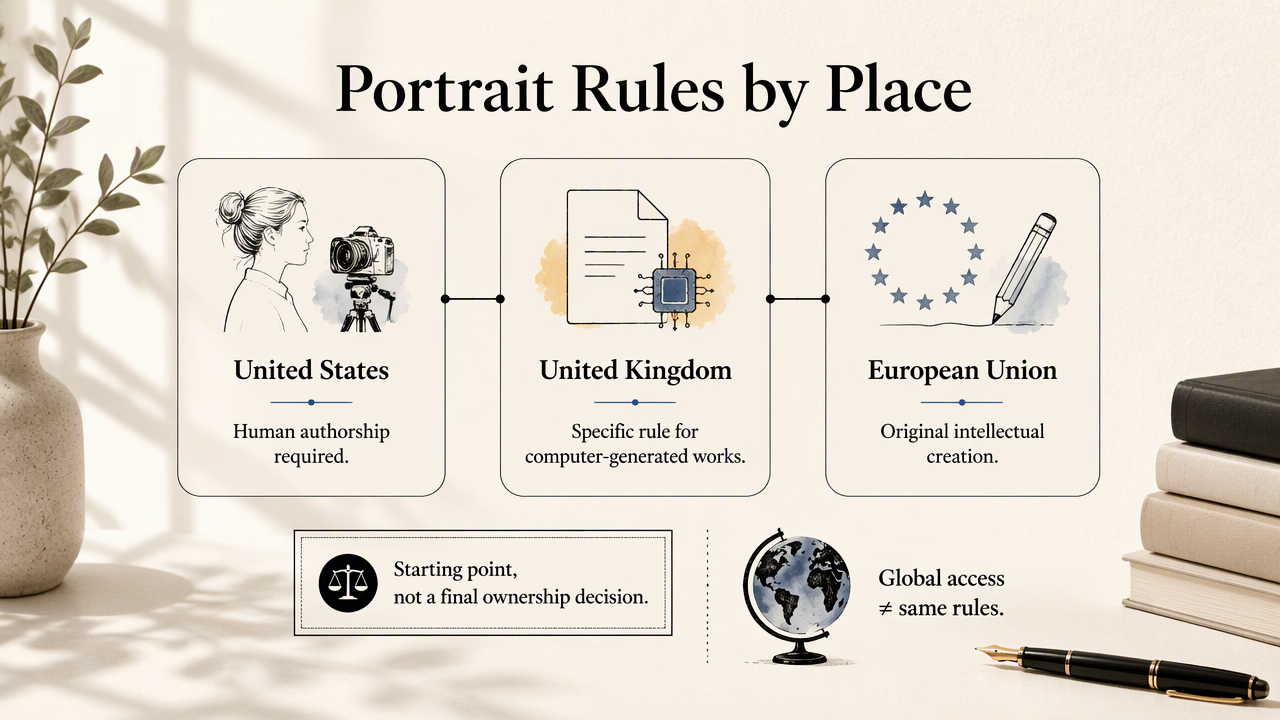
Jurisdiction and authorship decision table
The following frameworks provide a starting point, not a final ownership determination.
| Jurisdiction | Relevant framework | Practical portrait decision |
|---|---|---|
| United States | Human-authored expression is required; machine-generated elements aren't protected on their own | Identify original human contributions before claiming copyright |
| United Kingdom | Section 9(3) addresses authorship of computer-generated literary, dramatic, musical, or artistic works | Assess who undertook the necessary arrangements and whether other legal requirements are met |
| European Union | Originality requires an author's own intellectual creation | Examine the human creative choices expressed in the finished work |
The UK provision appears in section 9 of the Copyright, Designs and Patents Act 1988. Its wording shouldn't be treated as an automatic guarantee that every AI headshot qualifies.
The EU originality standard is associated with decisions including Infopaq International, case C-5/08. That case predates generative AI and is a foundational copyright reference, not a ruling specifically approving AI portraits.
Which developments deserve attention after 2026?
Future developments may clarify how much human control is enough and how computer-generated-work provisions apply to modern tools. For commercial portrait projects, the useful habit is to check official guidance at publication or licensing time rather than rely on an old blog summary.
- Track guidance in the country where protection is sought.
- Keep the generation and editing dates with project records.
- Recheck rights before a major campaign or licensing deal.
What permissions matter besides copyright?
Permission to use an AI portrait depends on more than copyright eligibility: service terms, rights in uploaded photographs, and consent involving the depicted person can all matter. A commercially usable output isn't necessarily exclusive, and an unprotected output doesn't automatically clear every legal issue surrounding its creation or publication.
Commercial permission and exclusivity answer different questions
Commercial permission: Authorization under a service agreement to use an output for permitted business purposes.
Exclusivity: The ability to prevent certain competing uses, which requires a separate legal or contractual basis.
A service may allow profile pictures, websites, or advertising without promising enforceable copyright in the output. Terms should be checked for permitted uses, restrictions, and any distinction between personal and business accounts. Contractual rights generally govern the parties to that contract; they don't create copyright against everyone else.
A subject's face and a photographer's image carry different rights
Being pictured in a photograph doesn't automatically mean owning its copyright. A studio photographer may hold rights in the uploaded source image, while the subject may have separate privacy, publicity, or likeness interests depending on applicable law.
For example, an entrepreneur using an existing studio headshot should check whether the photography agreement permits uploading it to an AI service. An employer creating staff portraits should separately confirm employee consent and intended uses.
- Source-image rights: Permission to upload and transform the original photographs.
- Likeness rights: Authority to depict and use an identifiable person.
- Publication rules: Employer, professional-body, advertising, or platform requirements.
Research on broader human-AI collaboration, such as John V. Pavlik's 2023 media-education paper, offers context rather than legal authority. The same distinction applies to Weidinger and colleagues' 2022 language-model risk taxonomy: technology-risk scholarship doesn't establish portrait ownership.
How should a professional portrait workflow document rights?
A professional portrait workflow should document permissions and human contributions before publication:
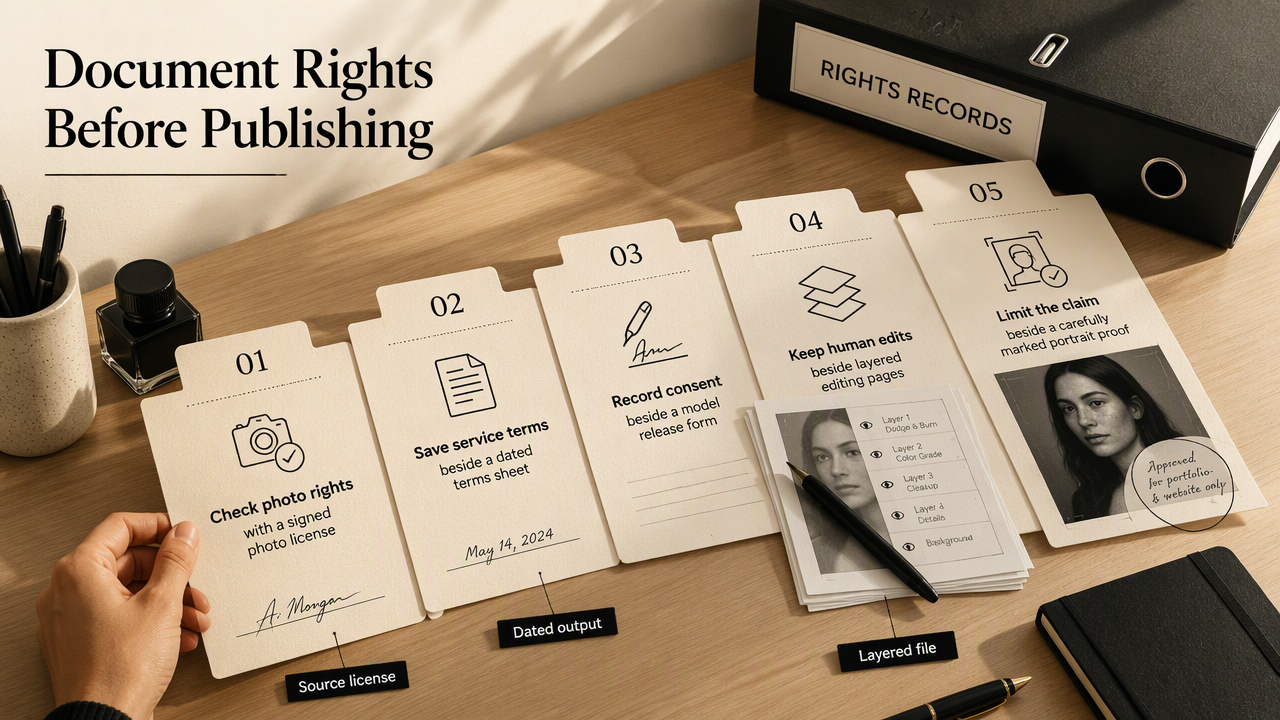
- Confirm rights to every uploaded photograph.
- Save the service terms applicable when generating the portrait.
- Record consent and approved uses for the depicted person.
- Preserve drafts showing original human edits.
- Describe any copyright claim narrowly and accurately.
Keep evidence that explains the creative process
Useful records include source-image licenses, dated outputs, layered editing files, and notes describing manually created elements. Prompt histories can explain the process, but they shouldn't substitute for evidence of human-authored expression.
For a U.S. registration involving AI material, applicants should follow Copyright Office guidance on identifying the human contribution and disclosing generated material. A claim should distinguish an original layout or painted addition from the underlying generated portrait.
Clear records also help teams coordinate publication. A simple project folder can contain the approved final image, intended channels, consent record, and relevant permissions.
How Looktara fits a professional portrait workflow
Looktara is relevant to professionals considering AI-generated imagery for career and personal-brand profiles. The Looktara platform can be considered within a documented workflow that treats image selection, creative editing, and publication approval as separate steps.
A useful brief specifies the intended channel, desired presentation, and any human-designed additions. Keeping those requirements together makes the portrait project easier to review and helps the final image serve a clear professional purpose.
Frequently asked questions about AI portrait rights
AI portrait rights depend on the specific output and agreement, so common ownership questions need separate answers.
Does paying for an AI headshot make it copyrighted?
Paying for an AI headshot doesn't establish human authorship or guarantee copyright protection. Payment may purchase generation services and contractual permission to use the result. The applicable terms explain that permission, while copyright law determines whether the finished image contains protectable expression. Purchase records are useful, but they aren't proof of authorship.
Can an AI portrait appear on LinkedIn without copyright registration?
Copyright registration isn't ordinarily a prerequisite for posting a portrait on LinkedIn. The relevant checks are permission to use the output, rights in source photographs, consent where needed, and applicable platform or employer rules. A generated image can be authorized for profile use even when its machine-generated elements aren't copyrightable.
Does editing an AI portrait guarantee protection?
Editing doesn't guarantee protection because not every change contains sufficient original human expression. A custom illustration or creative composition may qualify, while routine technical adjustments may not. Any protection generally covers the qualifying human contribution rather than automatically extending to the entire generated image. There isn't a universal number of edits that ensures eligibility.
Can someone else copy an unprotected AI portrait?
If the portrait has no protectable authorship, copyright may not provide a basis to stop copying that output. Other legal grounds may still matter, including misuse of someone's likeness, misleading endorsement, or contractual restrictions. Those protections have different requirements and shouldn't be assumed merely because the image depicts an identifiable professional.
Conclusion
Choose a portrait and keep a rights record
A strong professional portrait starts with a clear purpose and a documented publishing plan. The next step is to gather source-photo permissions, save applicable terms, and retain evidence of original creative work.
Professionals ready to plan an AI portrait can explore Looktara and visit looktara.com as part of that preparation. For projects requiring exclusive licensing or a copyright registration, arrange a legal review before making ownership promises.
Generated by EarlySEO.com