
TL;DR
Board directors should choose AI headshots that look credible, current, and consistent across board bios, annual reports, LinkedIn, and media kits. The safest workflow is to start with strong source photos, select a conservative executive style, check identity accuracy, and publish only images that match governance expectations.
An AI headshot for board directors has to do more than look polished, since a director's image often appears beside governance credentials, investor communications, annual reports, and media coverage. Board of directors: a governing body that supervises the activities of a business, nonprofit organization, or government agency. AI headshot: a computer-generated or AI-enhanced professional portrait created from uploaded photos or prompts. For directors who need a credible image without booking a studio, Looktara can support a faster executive photo workflow while related assets, such as a professional resume-style headshot, keep public profiles consistent.
Table of Contents
What is an AI headshot for board directors?
An AI headshot for board directors is a professional executive portrait created or refined with artificial intelligence for use in board bios, company websites, investor materials, conference pages, and LinkedIn profiles. It should preserve identity, convey authority, and match the formal communication standards expected around corporate governance.
Board imagery sits in a different category from casual profile photography. A director's photo may be reviewed by investors, regulators, journalists, founders, nonprofit stakeholders, and executive search firms. That makes realism, restraint, and consistency more important than dramatic styling.
AI headshot tools typically work from uploaded selfies or existing portraits. Some tools generate new backgrounds, adjust attire, improve lighting, and create multiple versions for different professional contexts. The best result still depends on clear source images, accurate facial detail, and a style brief that favors trust over trendiness.
Key insight: A board-ready portrait should look like the director on a strong day, not like a different person in an expensive room.
Board director use cases that need one polished image
Board directors often need the same portrait adapted across formal and semi-formal channels. A single approved image can reduce mismatched visuals across public materials.
Common use cases include:
- Board biography pages and committee profiles
- Annual reports and governance reports
- Investor relations pages
- Speaker bios for industry events
- LinkedIn profile updates and company announcements
- Press kits, podcast guest pages, and media interviews
Digital presence now carries more weight because board work, executive networking, and public reputation often happen through screens. Hannah Zeavin's 2021 MIT Press book, The Distance Cure, examined mediated communication and remote presence, a useful context for why professional images matter when leadership interactions are increasingly digital.
How should board directors choose the right executive headshot style?
Board directors should choose a headshot style that matches the organization's sector, governance role, and public audience rather than chasing a generic "CEO" look. The safest direction is clean lighting, neutral expression, formal or smart business attire, and a background that does not compete with the face.
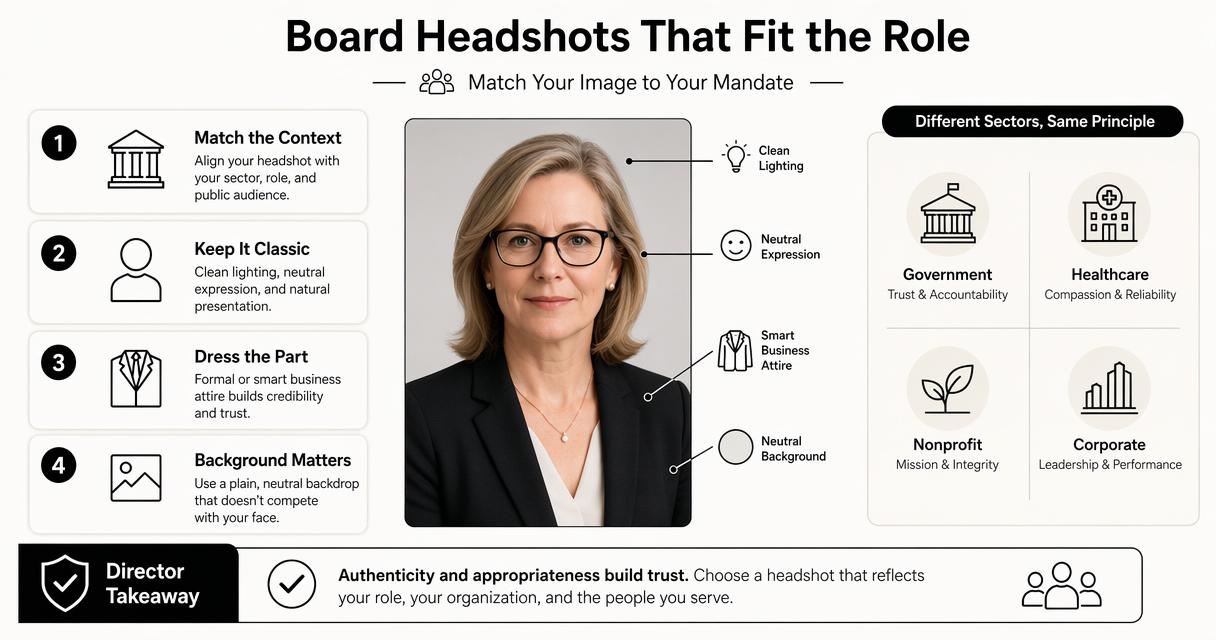
A director at a regulated financial institution may need a more conservative image than a director at a venture-backed software company. Nonprofit trustees may benefit from a warmer expression, while public company directors often need a more formal and understated portrait.
For profile distribution, the portrait should also work with supporting content. A director announcing a board appointment can pair the image with a professional LinkedIn post graphic, while a founder-director can use the same visual system in investor materials or a pitch deck slide.
Executive style comparison for board contexts
| Board context | Recommended look | Best background | Style to avoid |
|---|---|---|---|
| Public company board | Formal suit or blazer, composed expression | Gray, navy, office, or studio | Glamour lighting or trendy filters |
| Startup advisory board | Smart business attire, approachable expression | Modern office or clean neutral | Overly corporate stock-photo style |
| Nonprofit board | Warm expression, polished but human | Soft neutral or mission-aligned setting | Stiff, distant, or luxury-coded styling |
| Financial services board | Conservative tailoring, direct gaze | Studio gray, dark blue, boardroom | Casual clothing or dramatic edits |
| Personal brand board profile | Confident expression, modern attire | Clean editorial or office setting | Heavy retouching or altered features |
The most reliable style is usually "executive editorial," not "luxury boardroom." A portrait can show seniority through posture, clothing, and lighting without using props that feel staged.
Practical selection checklist
A good director headshot should pass a simple credibility review before publication.
- Confirm that the face, eyes, smile, and jawline match the real person.
- Select attire that fits current board and sector expectations.
- Choose a background that will not date quickly.
- Test the image at small sizes for LinkedIn and speaker pages.
- Save one formal crop and one wider crop for media teams.
- Keep color grading consistent across board members when possible.
Daniel Hoang and Kevin Wiegratz's 2022 article, "Machine learning methods in finance: Recent applications and prospects", reflects how machine learning has become part of serious business functions. That context matters because directors in finance, governance, and strategy should treat AI-generated imagery as a professional communication asset, not a novelty.
How does Looktara fit into a board director image workflow?
Looktara fits a board director image workflow by helping create polished, role-appropriate visual assets that can support executive profiles, appointment announcements, investor-facing materials, and social updates. The Looktara platform is most useful when the director already has a clear brief: credible, current, and consistent.
A board portrait rarely stands alone. It often appears inside a larger communication system, including a company profile page, announcement post, pitch deck, podcast cover, or website hero. That is where coordinated AI visuals can help maintain a unified professional presence without sending every asset through a long creative production cycle.
For founders, operators, and independent directors, looktara.com can serve as a central place to build visual material around leadership identity. A headshot can anchor the profile, while related assets such as a website hero visual or professional X post graphic can carry the same tone into public announcements.
A simple board-ready workflow
A practical workflow keeps the image useful beyond one profile upload.
- Define the audience: investors, employees, nonprofit stakeholders, media, or search committees.
- Choose the style: formal boardroom, studio executive, editorial office, or warm nonprofit profile.
- Generate several options and reject anything that changes identity.
- Select one primary image and one backup crop.
- Use the approved image across board bios, LinkedIn, decks, and media kits.
- Refresh the image after major role changes, rebrands, or visible appearance changes.
Key insight: Consistency is not vanity. For board directors, consistent imagery reduces friction when stakeholders compare bios, announcements, and public profiles.
Where AI assets support the headshot
Board directors often need images for adjacent professional channels. A headshot may lead the profile, but supporting graphics give communications teams more flexibility.
Useful pairings include:
- Board appointment announcement graphics
- Investor update visuals
- Conference speaker tiles
- Podcast guest covers
- Founder or operator website sections
- Thought-leadership social posts
For directors connected to founder-led brands, a coordinated AI logo concept can sit beside the headshot in early brand materials. The point is not to make every asset look identical. The goal is visual alignment, so the person, company, and public message feel related.
What should directors check before publishing an AI-generated headshot?
Directors should check identity accuracy, disclosure expectations, brand fit, and governance sensitivity before publishing an AI-generated headshot. The image should never create confusion about age, appearance, role, status, location, or affiliation, especially when it appears in investor-facing or public accountability contexts.
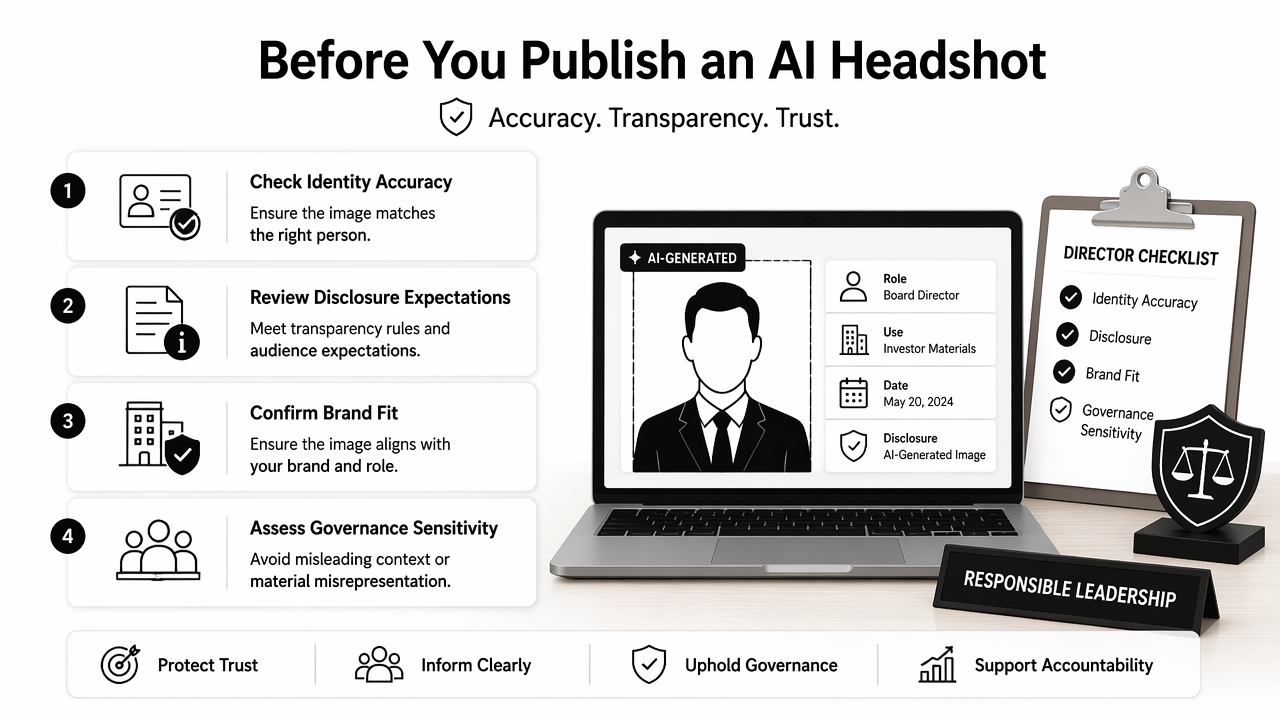
The main risk is not that AI was involved. The real risk is misrepresentation. A board portrait that changes facial structure, removes defining features, invents a luxury setting, or makes the director look significantly younger can weaken trust.
Some organizations may also have communication rules for board pages, media kits, and annual reports. A public company, regulated financial firm, healthcare organization, or nonprofit may require communications approval before publishing new director imagery.
Pre-publication review list
Use a short approval process before the image goes live.
- Identity match: facial features, skin tone, hair, and expression look accurate.
- Professional context: clothing and background fit the organization's sector.
- Image rights: uploaded source photos are owned or approved for use.
- Stakeholder sensitivity: the image does not imply wealth, location, office access, or status that may be misleading.
- Technical quality: the file is high resolution and works in square, vertical, and horizontal crops.
- Team consistency: board member photos look reasonably aligned on the same page.
A careful review also helps avoid awkward mismatches between in-person appearances and public imagery. The strongest AI-generated portrait feels familiar when the director joins a video call or appears at an event.
Common mistakes to avoid
The weakest board portraits usually fail because they try too hard. Heavy smoothing, unreal wardrobe details, fake office reflections, and overly dramatic lighting can make an image look synthetic.
Avoid these choices:
- Clothing that does not match the director's normal professional style.
- Backgrounds that imply a company office or boardroom the director has never used.
- Facial edits that change age, expression, or recognizability.
- Crops that cut too tightly for media use.
- Multiple public headshots with different hair, face shape, or style.
AI tools keep improving, but governance roles still demand restraint. Pippin Barr's 2023 MIT Press book, The Stuff Games Are Made Of, discusses digital systems and made objects in another context, but the broader lesson applies: generated outputs are designed artifacts, and artifacts need judgment before public use.
Frequently asked questions about AI headshots for board directors
Board directors can use AI-generated headshots when the final image is accurate, professional, and approved for the intended public context. The answers below cover the most common concerns around credibility, usage, and timing.
Can board directors use AI headshots on official company websites?
Yes, board directors can use AI headshots on official company websites if the image accurately represents the person and follows the organization's communications policies. Public companies, regulated industries, and nonprofits may require review by legal, investor relations, or communications teams before publishing a new director photo.
What makes a board headshot look trustworthy?
A trustworthy board headshot has accurate facial features, natural skin texture, clear eyes, modest retouching, and clothing that fits the director's sector. Neutral backgrounds, balanced lighting, and a direct but relaxed expression usually work better than dramatic poses or luxury-coded boardroom imagery.
How often should a director update a professional headshot?
A director should update a professional headshot after a visible appearance change, a new board appointment, a company rebrand, or a shift in public role. Many directors refresh imagery when a current portrait no longer matches media appearances, conference bios, or LinkedIn networking activity.
Should an AI-generated portrait be disclosed?
Disclosure depends on the organization, channel, and use case. A lightly AI-assisted headshot used for lighting or background polish may not need special labeling, while a fully generated portrait may require internal review. The safest approach is to follow company policy and avoid any image that could mislead stakeholders.
Conclusion
A board director's image is part of governance communication, not just personal branding. The best AI headshot for board directors looks accurate, polished, and restrained enough for annual reports, LinkedIn, investor pages, and speaking profiles.
A practical next step is to gather recent source photos, define the board context, generate several conservative options, and run the final image through a credibility review before publication. For directors who want a faster visual workflow around executive profiles and public announcements, Looktara can help create polished assets, and more options are available at looktara.com.
Generated by EarlySEO.com