
TL;DR
AI headshots can be useful for LinkedIn, websites, pitch decks, and social profiles, but the safest choice depends on consent, usage rights, privacy terms, and how closely the image represents a real person. Professionals should keep source photos, read commercial-use terms, avoid misleading edits, and choose platforms that make profile and brand use clear.
AI headshot likeness rights now sit at the center of a practical question: can a polished synthetic portrait be used for work, marketing, or social profiles without creating legal or reputational trouble? The answer is usually yes when the person controls the uploaded photos, has permission to use the output, and avoids deceptive use. AI headshot likeness rights: the permissions, privacy expectations, and identity protections connected to generating and using an AI-made image that resembles a real person. For professionals who need profile-ready imagery, tools such as Looktara can fit into a safer content workflow when image use is planned before posting.
Table of Contents
What are AI headshot likeness rights?
AI headshot likeness rights are the practical permissions and identity interests tied to an AI-generated image that looks like a real person. They cover who supplied the source photos, who may use the generated image, whether commercial use is allowed, and whether the result could mislead an audience.
Likeness is not the same as copyright. A person may have privacy or publicity interests in a face, name, voice, and identity, while copyright usually concerns authorship of a specific creative work. That distinction matters because an AI portrait can look personal even when copyright ownership is unclear.
Key takeaway: a safe AI headshot is not just attractive; it is consented to, accurate enough for context, and covered by clear usage terms.
Research on generative AI privacy and security, including the 2024 IEEE Access survey by Abenezer Golda, Kidus Abebe Mekonen, and Amit Pandey, examines risks around personal data, model behavior, and user trust in generative systems (IEEE Access paper). A 2024 paper by Mohamed Chawki also discusses legal challenges around deepfakes in the American context, which is relevant when synthetic media imitates real identity (Cogent Engineering paper).
The most practical rule is simple: use only images of the person whose headshot is being created, review platform terms, and keep the final portrait honest for its setting.
What rights matter before using an AI headshot?
The rights that matter most before using an AI headshot are source-photo permission, output usage rights, commercial-use terms, privacy handling, and platform rules. These checks help professionals decide whether a headshot is safe for LinkedIn, company pages, resumes, ads, and creator profiles.
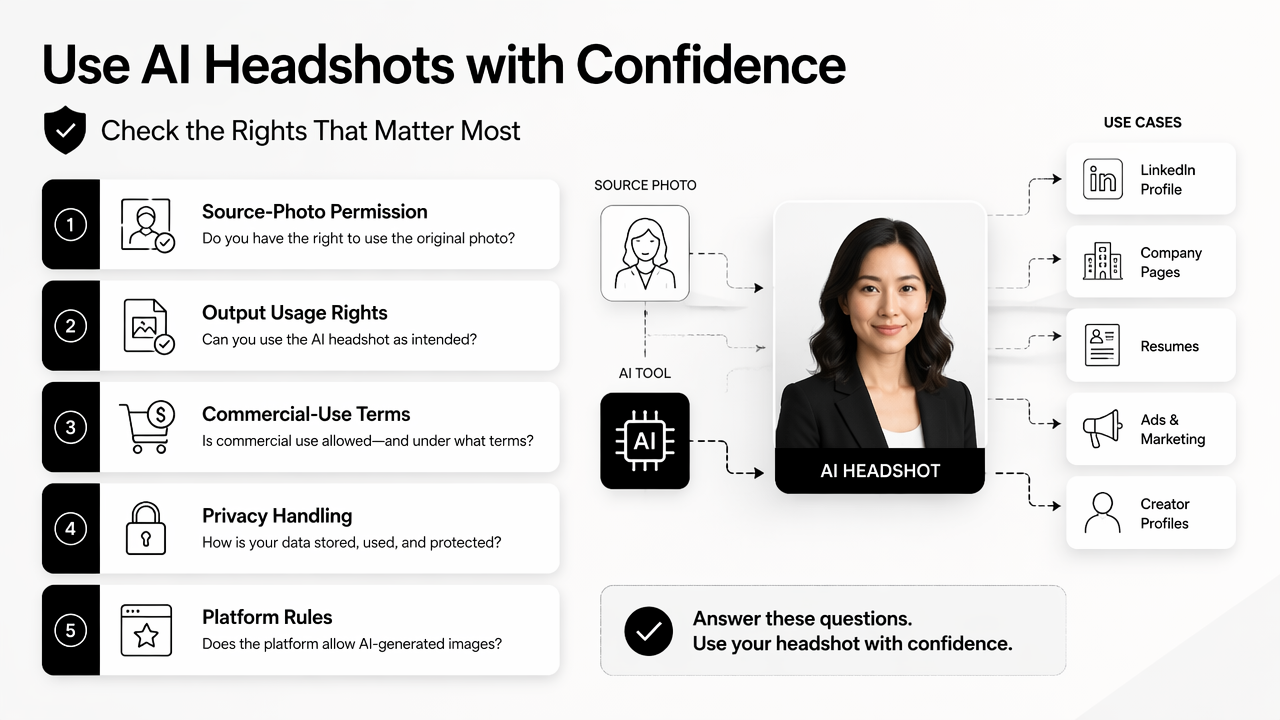
Rights checklist for common profile uses
| Use case | Main question to ask | Practical action |
|---|---|---|
| LinkedIn profile | Does the image truthfully represent the person? | Avoid age, role, uniform, or credential changes that imply false status. |
| Resume or CV | Is the output allowed for professional use? | Save the provider's commercial-use or personal-use terms. |
| Company website | Does the employer have permission to publish it? | Confirm approval from the person shown before posting. |
| Ads and marketing | Are paid placements allowed? | Check whether the platform grants commercial marketing rights. |
| Dating profile | Is the image authentic enough for social trust? | Use a realistic output, not a heavily altered identity. |
Copyright deserves careful wording. Some viral advice says AI users never own AI headshots, but the better practical answer is more nuanced. In the United States, copyright protection generally requires human authorship, while contract terms can still grant broad rights to use, download, publish, or commercially display an output. For most users, the license and terms of service matter more than abstract ownership language.
A separate issue is the right of publicity, which protects against unauthorized commercial use of a person's identity in many places. A founder using an AI headshot of that founder is different from a business using a contractor's AI portrait in ads without written approval.
For career use, a profile photo can pair with branded content such as a fitness Shopify LinkedIn post generator, but the headshot and surrounding message should tell the same truthful story.
How can professionals use AI headshots safely?
Professionals can use AI headshots safely by starting with authorized images, choosing realistic outputs, saving the service terms, limiting sensitive uploads, and matching the image to the channel. Safe use is less about fear and more about keeping consent, accuracy, and context aligned.
A practical 6-step review before posting
- Use only owned or authorized source photos. Selfies, existing portraits, or employer-approved images are cleaner than photos taken by someone else without permission.
- Read the output license. Look for personal use, commercial use, advertising use, sublicensing, and deletion language.
- Check whether training use is optional. Prefer services that explain whether uploads may be used to improve models.
- Pick a realistic result. A headshot should not change age, body type, disability status, credentials, or job role in a misleading way.
- Save proof. Keep source images, receipts, selected outputs, and a dated copy or screenshot of key terms.
- Match the channel. A polished board bio can differ from a casual dating profile, but both should remain recognizable.
Privacy deserves special attention because headshot generation depends on biometric-like face data. The 2024 IEEE Access survey on generative AI privacy and security covers broad concerns around data protection and generative systems, which supports a cautious approach to uploads (IEEE Access paper).
Deepfake research also matters beyond video. A 2023 survey by Zahra Khanjani, Gabrielle Watson, and Vandana P. Janeja examined audio deepfakes, showing how synthetic media can raise authentication and impersonation concerns across formats (Frontiers in Big Data paper).
For business owners, the same caution applies across assets. A website banner, sales deck, and founder portrait should feel consistent, which makes tools such as a fitness Shopify website hero AI generator or fitness Shopify pitch deck slide AI generator useful when brand imagery needs a clear visual system.
How Looktara handles practical headshot use
Looktara supports practical headshot use by helping professionals create profile and brand visuals for specific business contexts rather than treating every image as a generic AI experiment. The stronger approach is to plan the destination first, then create an image that fits that destination.
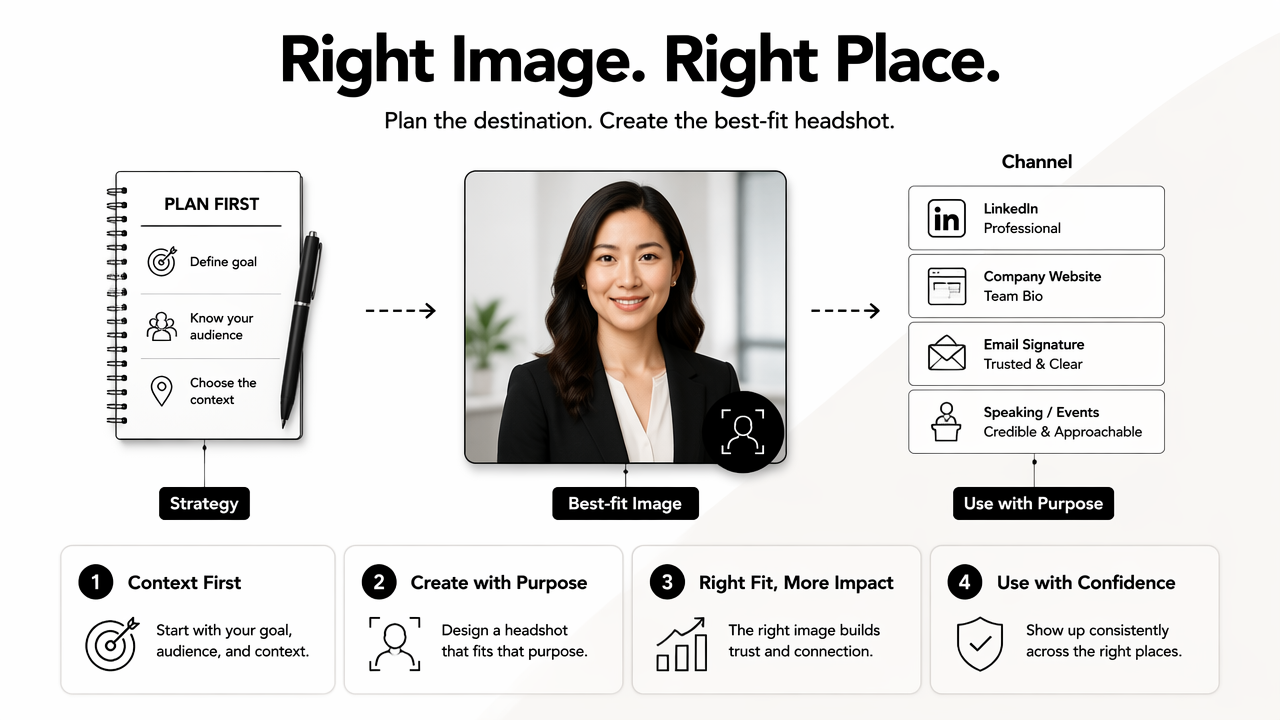
Best-fit channels for AI-generated professional imagery
| Channel | Best-fit image style | Why likeness rights matter |
|---|---|---|
| Clear, current, professional portrait | Recruiters expect an accurate representation. | |
| Resume | Conservative headshot where culturally appropriate | The image may travel with job documents. |
| Founder website | Polished but realistic brand portrait | The person's identity supports trust and authority. |
| Creator profile | Expressive, recognizable portrait | Audience trust depends on authenticity. |
| Dating app | Natural, current, honest image | Misrepresentation can harm real-world trust. |
The Looktara platform is most relevant when a user needs images connected to a real professional goal, such as a resume, a personal brand update, or a launch asset. For example, a fitness Shopify resume headshot AI generator can support a career-facing workflow where the image needs to look credible rather than theatrical.
A good workflow separates identity, brand, and distribution. Identity asks whether the person shown consented. Brand asks whether the image fits the role, company, or audience. Distribution asks whether the image may appear on LinkedIn, a website, a media kit, or paid marketing.
For social content, profile visuals often sit beside posts, thumbnails, and covers. A creator updating a headshot may also need matching assets from a fitness Shopify TikTok cover AI generator, as long as the overall presentation remains honest. More examples are available on looktara.com for teams building a consistent visual presence.
What should change in 2026 and 2027?
AI likeness practice in 2026 and 2027 should move toward clearer consent records, better labeling, stricter platform policies, and more visible controls over training data. The direction is practical: synthetic portraits will become normal, but undocumented identity use will become harder to defend.
Signals to watch before the next profile refresh
- Platform labels: social networks and hiring platforms may expand rules for synthetic or edited media.
- Employer policies: companies may ask staff to disclose or approve AI-generated team portraits.
- Model-release habits: written consent may become standard for contractors, creators, and employees.
- Data deletion controls: users will likely expect clearer upload deletion and model-training choices.
- Brand consistency tools: businesses may prefer image systems that connect headshots with posts, covers, and site graphics.
A non-legal but careful process works best. Before publishing, the user or organization should be able to answer three questions in plain language: whose face is shown, who approved the use, and where the image will appear.
Practical standard for 2026: if the same explanation would sound fair to a recruiter, client, employer, date, or business partner, the headshot is probably being used in the right spirit.
Synthetic media rules will not remove the need for judgment. A technically permitted image can still feel misleading if it suggests a role, age, setting, or lifestyle that does not match reality. A trustworthy headshot should improve presentation without rewriting identity.
FAQ about AI headshot likeness rights
Can an AI headshot be used on LinkedIn?
An AI headshot can generally be used on LinkedIn when it truthfully represents the person, follows the generator's usage terms, and does not imply false credentials, employment, or status. A clean business portrait is lower risk than an image that changes age, role, uniform, or professional setting in a misleading way.
Who owns an AI-generated headshot?
Ownership depends on copyright law, human creative input, and the platform's contract terms. For everyday use, the more practical question is whether the service grants permission to download, post, and use the output commercially. Saving the relevant terms is a smart recordkeeping habit.
Can a company use an employee's AI headshot?
A company should get clear permission before using an employee's AI headshot on a website, sales deck, recruiting page, or advertisement. Written approval is especially helpful when the image will remain online after a role changes or when the portrait appears in marketing rather than internal communications.
Is it okay to upload old professional photos into an AI generator?
Old professional photos may involve photographer rights, employer rights, or model-release limits. A safer path is to use self-taken images or photos covered by permission for derivative or AI-assisted use. When the photo was created under a contract, the contract should be checked before upload.
What is the safest next step before publishing?
The safest next step is a quick rights audit: confirm source-photo permission, review commercial-use terms, choose a realistic output, save records, and match the image to the intended channel. For branded assets beyond the portrait, visit looktara.com and build a consistent image set with clear usage intent.
Conclusion
AI headshot likeness rights are manageable when consent, accuracy, privacy, and usage terms are checked before publication. Professionals should treat a generated portrait like any other public identity asset: keep records, avoid misleading edits, and choose the right image for the right channel. For the next profile update, start with authorized photos, select a realistic result, save the terms, and use Looktara when a polished headshot needs to fit a broader personal brand or business content plan.
Generated by EarlySEO.com