
TL;DR
Kashmiri-inspired AI portraits work best when prompts name specific garments, modest styling, natural light, and believable settings. The safest approach is to avoid costume language, keep identity details respectful, and generate several variations before editing the strongest image.
A strong Kashmiri portrait prompt is less about adding random embroidery and more about combining accurate clothing, soft light, and a grounded setting. Kashmiri traditional look AI photo prompts can create graceful profile photos, creative portraits, and heritage-inspired edits when the prompt respects regional details instead of turning culture into a costume. For users who want polished personal imagery without a full photoshoot, Looktara offers a practical way to turn ordinary photos into styled portrait concepts while keeping the result clear, modern, and profile-ready.
Kashmiri traditional look: a portrait style inspired by Kashmir Valley clothing, winter layering, jewelry, textile textures, and settings such as chinar trees, wooden interiors, snow peaks, gardens, or neutral studios.
Table of Contents
What are Kashmiri traditional look AI photo prompts?
Kashmiri traditional look AI photo prompts are text instructions that guide an image model to create portraits with Kashmir-inspired clothing, accessories, scenery, lighting, and facial realism. The best prompts specify garments such as a pheran, fabric texture, modest styling, location, camera angle, and editing style in one clear instruction.
The SERP for this topic is filled with short prompt dumps and image-generator pages. One Neural.love listing for a "traditional dress of kashmiri girl" page says its users generated 60,155,735 images, showing broad demand for fast AI visuals, but the page gives little cultural or styling guidance Neural.love AI art generator. A stronger prompt collection needs more than "beautiful Kashmiri girl in dress."
Kashmiri identity is not a single outfit. The Kashmir Valley includes Muslim, Hindu, Sikh, and other communities, each with different family customs and styling choices. Wikipedia describes Kashmiri Pandits as Kashmiri Hindus from the Kashmir Valley and part of the larger Saraswat Brahmin community, which is a useful reminder that "Kashmiri" should not be treated as one flat visual category.
Key insight: A respectful prompt names visual elements, not stereotypes. Clothing, jewelry, setting, and light should do the work, while ethnicity and religion should be handled only when relevant and accurate.
Core prompt terms for AI models
| Term | Meaning in a prompt | Best use |
|---|---|---|
| Pheran | A loose traditional outer garment associated with Kashmir | Main clothing detail for winter or heritage portraits |
| Taranga | A traditional headgear associated especially with Kashmiri Pandit women | Use only when culturally relevant |
| Dejhoor | Traditional Kashmiri Pandit ear ornament | Use for specific ceremonial styling, not generic portraits |
| Chinar | Iconic maple-like tree associated with Kashmir imagery | Autumn outdoor backgrounds |
| Kangri | Traditional fire pot often used under clothing for warmth | Winter lifestyle scenes, handled subtly |
| Papier-mache pattern | Decorative Kashmiri craft style | Studio backdrop, props, or border motifs |
Prompt formulas that create realistic Kashmiri portraits
A reliable Kashmiri portrait prompt follows a five-part formula: subject, traditional styling, setting, lighting, and realism controls. This structure works across Gemini-style photo editing, Midjourney-like image generation, and profile-photo workflows because it gives the model both creative direction and guardrails.
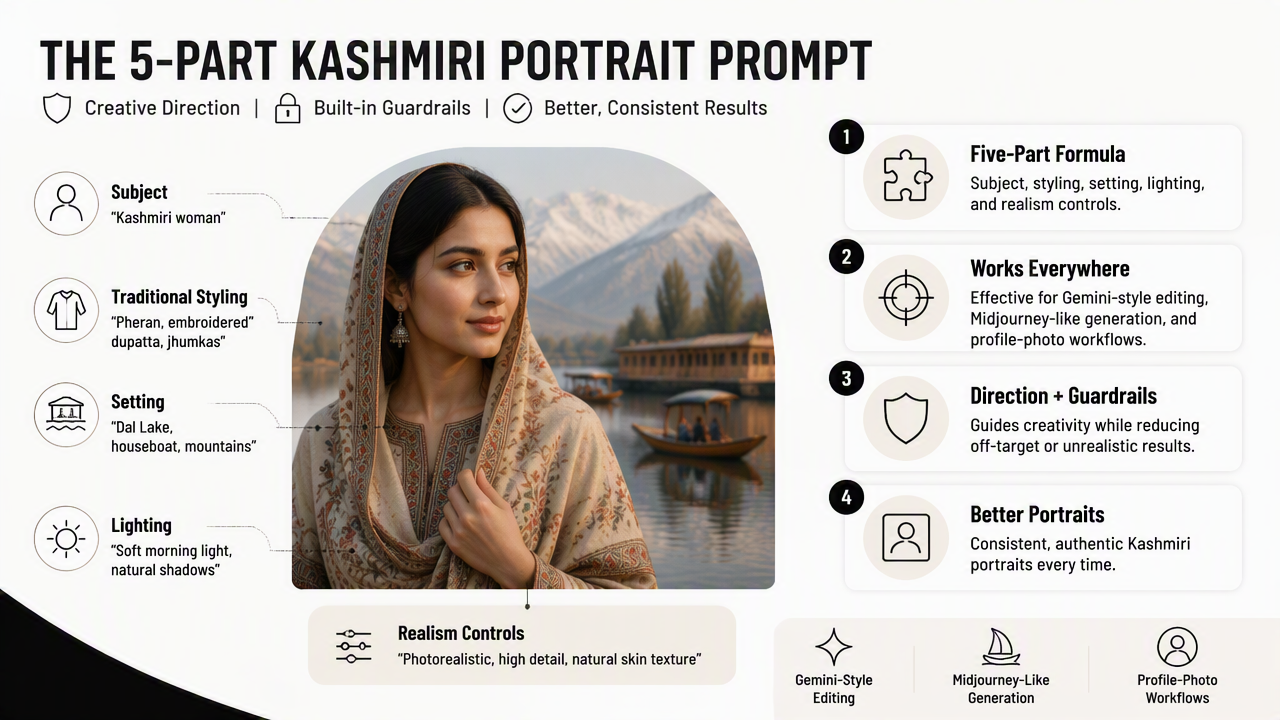
The best approach is to start with a simple base prompt, then add one or two culturally specific details. Too many ornaments, heavy makeup, dramatic snow, and palace-like sets can make the result look theatrical. A single pheran with tasteful embroidery often looks more real than a crowded festival costume.
Use this sequence for cleaner results:
- Describe the portrait type: headshot, half-body, seated portrait, outdoor editorial, or dating profile.
- Name the clothing: wool pheran, embroidered shawl, velvet pheran, or simple traditional outfit.
- Add one setting: chinar garden, Dal Lake-inspired backdrop, wooden Kashmiri room, snow mountain, or studio.
- Choose light: soft morning light, diffused window light, golden-hour glow, or clean studio lighting.
- Add realism controls: natural skin texture, accurate hands, realistic fabric folds, no over-sharpening.
For career portraits, creators can adapt the same approach into polished business imagery. A Kashmir-inspired profile can stay elegant and professional when paired with neutral lighting and clean composition, similar to the needs served by a LinkedIn product photo generator for professional profile visuals.
Ready-to-use prompt collection
- Classic pheran portrait: "Create a realistic half-body portrait of an adult person wearing a deep maroon wool pheran with subtle Kashmiri embroidery, natural skin texture, soft window light, calm expression, plain warm studio background, 85mm lens look, realistic fabric folds."
- Autumn chinar scene: "Generate a natural outdoor portrait in a Kashmiri autumn garden, adult subject in a cream pheran and muted pashmina-style shawl, fallen chinar leaves, soft golden-hour light, gentle depth of field, documentary realism."
- Snow valley portrait: "Create a realistic winter portrait with an adult subject wearing a charcoal pheran, light embroidered shawl, distant snow-covered mountains, soft overcast light, minimal makeup, natural face details, no fantasy styling."
- Elegant studio look: "Transform the uploaded portrait into a refined Kashmiri-inspired studio image, pastel pheran with delicate embroidery, simple earrings, beige backdrop, diffused portrait lighting, realistic expression, modern editorial finish."
- Dating profile style: "Create an authentic lifestyle portrait of an adult person in a simple blue pheran, relaxed smile, wooden balcony, soft daylight, shallow depth of field, candid photo style, natural proportions."
- Founder portrait: "Create a professional portrait of an entrepreneur in a minimal black pheran with fine sleeve embroidery, clean studio background, confident posture, soft side light, realistic face, polished but not glamorous."
Negative prompt controls
- Avoid: "princess," "exotic," "tribal," "costume," "overloaded jewelry," "fake snow," "plastic skin," "perfect doll face."
- Add: "realistic hands," "natural skin pores," "authentic fabric weight," "subtle embroidery," "modest styling," "clean background."
- For edits from real photos, request "preserve facial identity, age, face shape, and natural expression."
Which Kashmiri styling details should a prompt include?
A good Kashmiri styling prompt should include one main garment, one accessory, one background, and one lighting style. This keeps the image believable, especially for headshots, creator photos, and brand portraits where the face should remain the center of attention.
The pheran is usually the easiest anchor because it reads clearly in an AI image. Shawls, embroidered cuffs, and textured wool add visual context without forcing religious or ceremonial meaning. Accessories need more care. Terms such as taranga and dejhoor carry specific community associations, so they should not be used as generic decoration.
The setting should match the purpose of the image. A remote worker may need a clean studio portrait. A creator may prefer chinar leaves, a carved wooden window, or mountain haze. Social content can use richer scenery, while résumé or business images work better with less background activity.
Research on online communication and identity can help frame this. Banaji and Bhat's 2021 book Social Media and Hate examines how digital media can amplify social harm and identity-based hostility Social Media and Hate. For AI portrait prompts, that means cultural markers should be treated with care, context, and restraint.
Styling matrix by use case
| Use case | Best styling | Background | Prompt tone |
|---|---|---|---|
| LinkedIn headshot | Minimal pheran, neat shawl, no heavy jewelry | Warm studio or office wall | Professional, clean, realistic |
| Founder brand image | Dark pheran, fine embroidery, confident posture | Studio, carved wood, muted interior | Editorial, composed, premium |
| Instagram portrait | Colorful pheran, pashmina-style wrap | Chinar garden or balcony | Soft, expressive, lifestyle |
| Dating profile | Simple outfit, relaxed smile, natural grooming | Daylight balcony or garden | Candid, warm, approachable |
| Creative editorial | Velvet texture, patterned sleeve, stronger styling | Snow valley or papier-mache backdrop | Artistic, still believable |
Backgrounds that feel Kashmiri without clichés
Good backgrounds support the subject rather than overwhelm the portrait. Chinar leaves, walnut-wood interiors, papier-mache patterns, saffron-field color palettes, and distant mountains can all signal Kashmir in subtle ways.
For creator content, a vertical format can help. Portraits designed for reels, carousels, and posts can later be adapted through an Instagram product photo generator for visual content, especially when the same face and outfit need consistent branding across posts.
How can AI portraits stay realistic and respectful?
AI portraits stay realistic and respectful when prompts preserve identity, avoid caricatured language, and limit cultural details to accurate, context-aware styling. A good prompt should make the subject look like a real person wearing thoughtfully chosen clothing, not a fantasy version of a place.
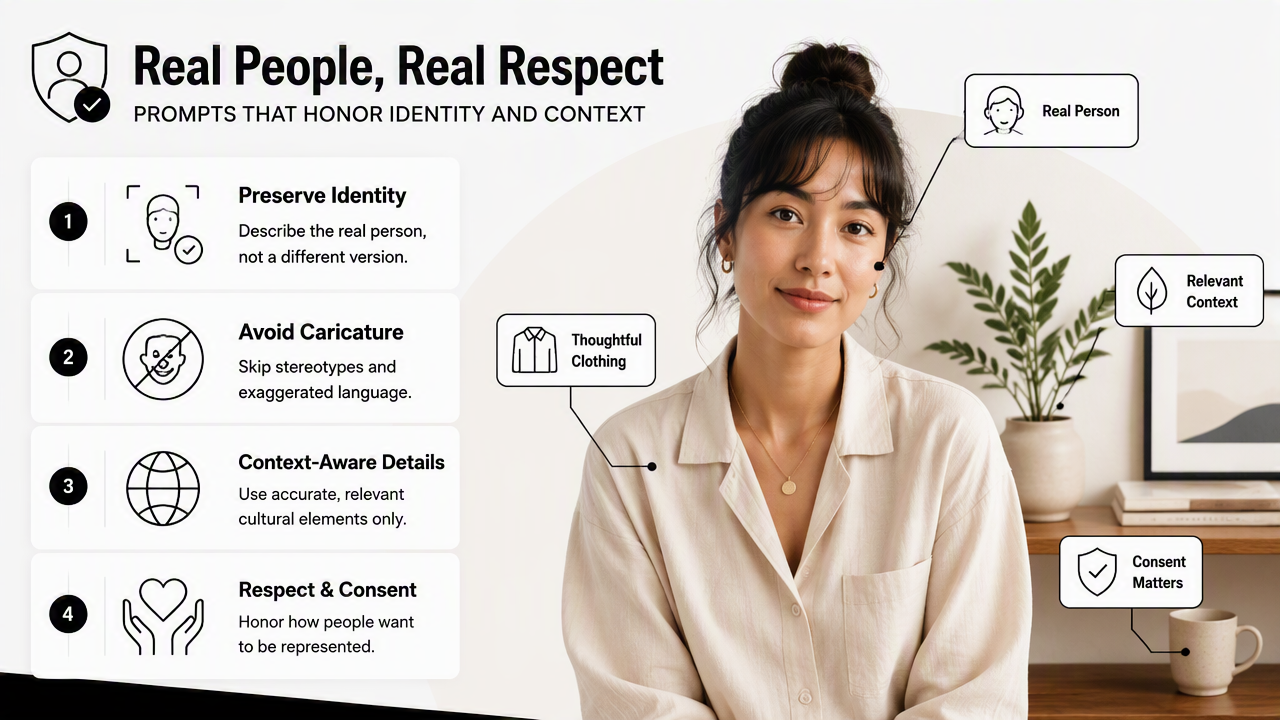
Respect also means avoiding a single "Kashmiri look" for everyone. Adult subjects should be described plainly. Skin tone, facial features, religion, class, and marital markers should not be invented by the model unless the source image or project brief justifies them.
Clarity matters in prompt writing. The Duolingo English Test: Technical Manual by Cardwell, Naismith, and LaFlair covers assessment design and language measurement technical manual. While the subject is different, the lesson for prompting is simple: clear instructions produce more consistent outputs than vague language.
Key insight: The most respectful AI prompt is specific about visible styling and quiet about identity claims that the image cannot responsibly verify.
Quality checklist before saving the image
- Check the face: identity, age, expression, and skin texture should remain natural.
- Check the clothing: fabric should fold like wool, velvet, or cotton, not plastic.
- Check the jewelry: ornaments should be placed correctly and not multiplied at random.
- Check the background: scenery should not fight the face for attention.
- Check the hands: fingers, sleeves, and shawl edges often reveal AI errors.
- Check the caption: cultural wording should be simple, respectful, and accurate.
For creators publishing seasonal or themed content, a polished portrait can become a newsletter hero image, profile banner, or visual opener. A newsletter product photo generator for branded images can help adapt one strong portrait into campaign-ready formats without over-editing the original concept.
Common prompt mistakes to avoid
- Using "Kashmiri princess" for every female portrait, which pushes the image toward fantasy.
- Adding too many markers at once, such as snow, lake, jewelry, palace, flowers, and festival makeup.
- Asking the model to change ethnicity or facial structure from an uploaded photo.
- Treating religious or community-specific accessories as generic fashion props.
- Over-smoothing skin until the portrait stops looking human.
How should more images like this be created in 2026?
More images like this should be created as a controlled series, not random one-off generations. In 2026, the best workflow is to build a repeatable prompt set, test three to five variations, keep the strongest face match, and export versions for profile, social, and brand use.
A simple series can include one studio portrait, one outdoor chinar portrait, one winter scene, and one close-up crop. This gives enough variety for social profiles, dating apps, newsletters, and creator platforms without making the styling feel inconsistent.
Looktara can fit this workflow when a user needs polished portraits from existing photos rather than starting from scratch. The Looktara platform is especially useful when the goal is a professional-looking image set for different channels, while still keeping the subject recognizable. For visual discovery platforms, a refined portrait can also be adapted through a Pinterest product photo generator for shareable images.
By 2027, AI portrait tools are likely to put more emphasis on identity preservation, consent, provenance labels, and culturally aware prompt defaults. That shift should benefit users who want tasteful regional styling without exaggerated features or misleading edits.
FAQ
What is the best prompt for a Kashmiri pheran portrait?
The best prompt describes an adult subject in a pheran, one fabric detail, one setting, and realistic light. A strong version is: "realistic half-body portrait, adult subject wearing a wool pheran with subtle Kashmiri embroidery, soft window light, natural skin texture, calm expression, warm studio background, 85mm portrait look."
Can these prompts be used for LinkedIn headshots?
Yes, if the prompt keeps the styling minimal and professional. A neutral background, soft studio light, simple pheran, and restrained accessories work better than a scenic mountain setting. The face should remain recognizable, with natural grooming and no exaggerated makeup or fantasy effects.
How can a prompt avoid looking like a costume?
A prompt avoids a costume effect by using fewer details and more realistic materials. One garment, one accessory, and one calm background usually look better than overloaded jewelry, dramatic scenery, and festival makeup. Words such as "documentary realism," "natural folds," and "subtle embroidery" help.
Are Kashmiri cultural accessories safe to include?
Cultural accessories are safest when used with context. A shawl or embroidered cuff is broadly suitable, while community-specific items such as taranga or dejhoor should be used only when the portrait brief calls for them. Generic use can make the image feel inaccurate or insensitive.
What is the best next step for creating a profile-ready image?
The best next step is to choose one prompt style, generate several versions, and select the image with the strongest face match and cleanest clothing details. After that, the portrait can be cropped for LinkedIn, Instagram, dating apps, or brand profiles. For guided portrait creation, visit looktara.com.
Conclusion
Kashmiri traditional look AI photo prompts work best when they balance beauty with accuracy: a clear pheran description, one meaningful accessory, a grounded setting, soft natural light, and identity-preserving realism. The strongest results avoid costume language and focus on believable portraits that can serve professional, social, or creative goals.
For the next image set, select three prompts from the collection, generate a studio version and an outdoor version, then compare face accuracy, fabric realism, and background restraint. With Looktara, creators and professionals can turn that chosen direction into polished images for profiles, campaigns, and personal branding. Head to looktara.com when a refined portrait set is ready to move from prompt idea to finished visual.
Generated by EarlySEO.com